
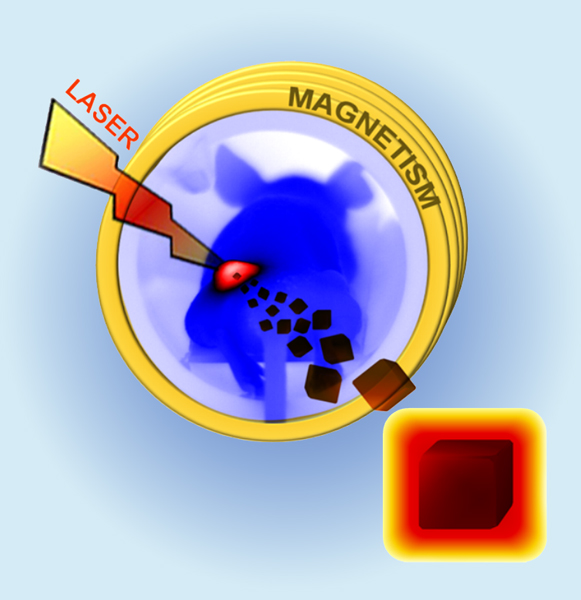
Cell therapies and medically oriented nanotechnologies are currently among promising biotechnologies. One attractive approach is to associate magnetic nanoparticles with cells in order to supply them with sufficient magnetization to be detectable by MRI, manipulated by magnetic forces, or treated with therapeutic hyperthermia.
We are exploring nanoparticles internalization in (human stem) cells. We investigate how intracellular magnetic nanoparticles allow applications of tissue engineering mediated by cellular magnetic force to mimic the most closely multicellular organisations found in the living. The aim is to confine cells in three dimensions at the millimetric scale by using home-designed miniaturized magnetic devices, in order to create cellular patterns for stem cell differentiation and tissue engineering.
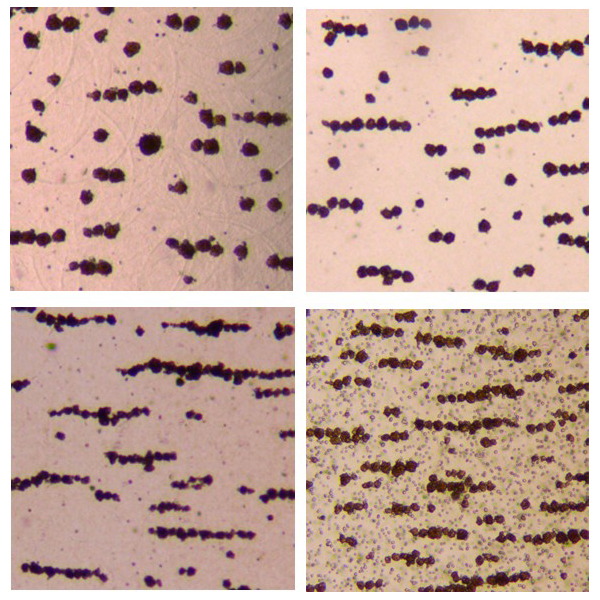
MAGNETIC CELLS ALIGNER
Another technique based on remote magnetic cell actuation is developed to align magnetically labeled cells in hydrogel. Remarkably, the hydrogel viscosity, before gel transition, allowed multilayer cell formation of aligned cell structures, at centimeter scale. The key stage then consist in exploiting gel transition to stabilize the pattern and create aligned, functional and viable tissues. Importantly, this strategy can be implemented without the need for external mechanical cues (no molds, frames nor posts). Instead, magnetic actuation provided high precision and accuracy for spatial and temporal pattern control.
Selection of publications
- Remote Magnetic Microengineering and Alignment of Spheroids into 3D Cellular Fibers. Demri N, Dumas S, Nguyen M, Groppero G, Abou-Hassan A, Descroix S, Wilhelm C. Advanced Functional Materials, 32, 2204850 (2022)
- 3D Magnetic Alignment of Cardiac Cells in Hydrogels. Richard S, Silva A, Mary G, Ragot H, Perez JE, Menager C, Gazeau F, Boucenna I, Agbulut O, Wilhelm C. ACS Applied Bio Materials, 3, 6802-6810 (2020)
MAGNETIC TISSUE STRETCHER
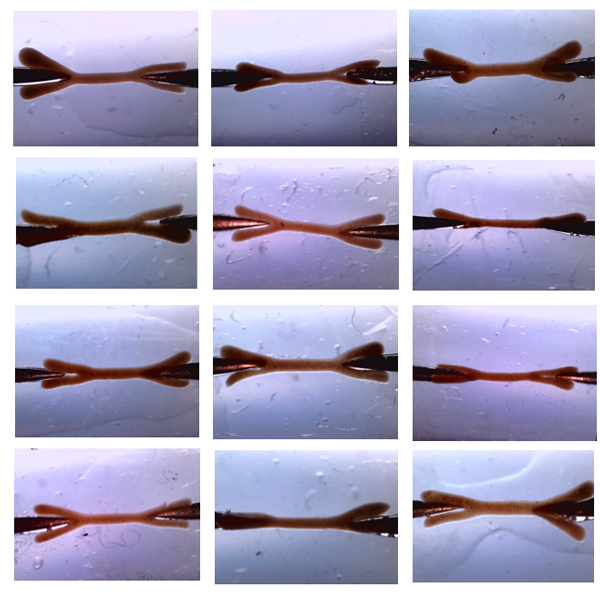
We are developing a magnetic tissue stretcher which provides a versatile tissue stimulator: frequency, longitudinal extension, speed of displacement and force amplitude can be varied at will. A 750 µm diameter soft iron tip magnetized either by a permanent magnet is first used to form a cell aggregate. A second identical tip is then approached. With the permanent magnet, the aggregate is rapidly deformed into a rectangular shape, and stretched when the second tip is drawn away.
Such stretching and compression capacity is particularly suited to cardiac and skeletal muscle geometry. For cardiac stimulation, a cyclic stretching was imposed, and resulted in almost total differentiation of embryonic mouse stem cells to cardiomyocytes.
Selection of publications
- Magnetic Bioprinting and Actuation of Stretchable Muscle Tissue. N Demri, L Morizur, S Dumas, G Gropplero, C Martinat, S Descroix, C Wilhelm. Advanced Healthcare Materials, 15, e03035 (2025)
- A 3D magnetic tissue stretcher for remote mechanical control of embryonic stem cell differentiation. Du V, Luciani N, Richard S, Mary G, Gay C, Mazuel F, Reffay M, Menasché P, Agbulut O, Wilhelm C. Nature Communications, 8, 400 (2017)
MAGNETIC SPHEROIDS
Magnetic molding of multicellular aggregates (spheroids)
Current limitations in standard techniques for spheroid formation persist and limit their applicability, like low degree of sphericity, poor control of spheroid size and long maturation times. We implement and reported a fast and highly reproducible spheroid generation technique to address these limitations based on the labeling of cells with magnetic nanoparticles and their subsequent aggregation by means of an external magnet.
Scale-up of magnetic spheroid formation and stimulation
Scalable Ni-based magnetic micropattern are developed for spheroid formation and stimulation. It provides a unique all-in-one solution to both create hundreds of spheroids, for instance made of embryoïd stem cells (embryoïd bodies) with no direct contact and no supporting matrix, in a high-throughput manner, and to stimulate them mechanically in situ (with electromagnet), in an on/off cyclical manner that mimics cardiac muscle contraction. It was sufficient to guide almost all embryoïd bodies towards the cardiac lineage commitment, a feat that was not reached with other approaches of embryoïd bodies differentiation.
Magnetic tissue rheometer
Finally, cells magnetization also allows developing a unique all-in-one rheometer by first forming a multicellular aggregates of controlled cylindrical shape, and then applying a precise magnetic compression at the tissue scale, to retrieve the rheological properties of the construct.
Selection of publications
- Surface Tension and Neuronal Sorting in Magnetically Engineered Brain‐Like Tissue. Perez JE, Jan A, Villard C, Wilhelm C. Advanced Science 2302411 (2023)
- Simple droplet microfluidics platform for drug screening on cancer spheroids. Parent C, Zhou Y, Aubert V, Surdez D, Delattre O, Wilhelm C*, Viovy J-L*. Lab on a chip 23, 5139-5150 (2023)
- A Label‐Free Machine Learning Prediction of Chemotherapy on Tumor Spheroids Using a Microfluidics Droplet Platform. C Parent, H Honari, T Tocci, F Simon, S Zaidi, A Jan, V Aubert, O Delattre, H Isambert, C Wilhelm*, J‐L Viovy. Small Science, 5, 2500173 (2025)
- Magnetic Compression of Tumor Spheroids Increases Cell Proliferation In Vitro and Cancer Progression In Vivo. G Mary, B Malgras, JE Perez, I Nagle, N Luciani, C Pimpie, A Asnacios, M Pocard, M Reffay, C Wilhelm. Cancers 14, 366 (2022)
- Magnetic molding of tumor spheroids: Emerging model for cancer screening. Perez JE, Nagle, I, Wilhelm C. Biofabrication 13, 015018 (2020)
- High‐Throughput Differentiation of Embryonic Stem Cells into Cardiomyocytes with a Microfabricated Magnetic Pattern and Cyclic Stimulation. Mary G, Van de Walle A, Perez JE, Ukai T, Maekawa T, Luciani N, Wilhelm C. Advanced Functional Materials 12002541 (2020)
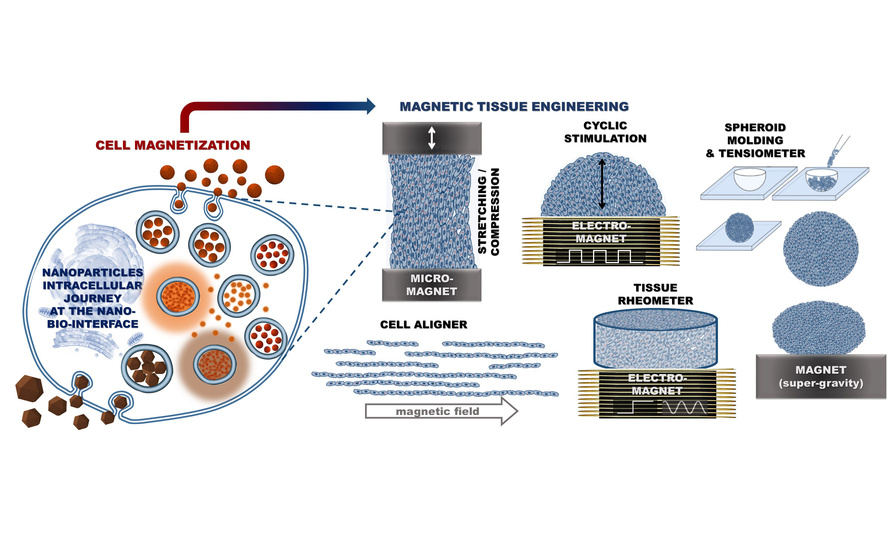
Summary of our magnetic tissue engineering approaches, starting with the incorporation of nanoparticles into cells (typically progenitor or stem cells), and encompassing the use of a tissue aligner, a tissue stretcher, the formation and stimulation of spheroids, as well as magnetic rheological measurements of tissues.