
MAGNETIC HYPERTHERMIA
The team’s work initially focused on highlighting the properties of magnetic nanoparticles that can be exploited in biological environments for cognitive or therapeutic purposes. These magnetic nanoparticles proved to be highly effective and non-destructive agents for cellular association. Their potential as imaging tracers, targeting agents, and local sources for magnetic hyperthermia was subsequently investigated.
Our first objective was to identify the mechanisms underlying hyperthermia induced by iron oxide nanoparticles, with particular emphasis on the respective contributions of Néel and Brownian relaxation. By independently varying particle size distribution (via prior size sorting), magnetic anisotropy, and medium viscosity, we obtained experimental results in quantitative agreement with theory accounting for size distribution. This analysis defined optimal particle specifications for therapeutic applications, highlighting the critical dependence of specific loss power (SLP) on nanoparticle size.We then investigated the heating efficiency of nanoparticles within cells. Using controlled cell labeling, precise quantification, known intracellular distributions, and two particle types modulating Brownian contributions, we demonstrated that intracellular heating is governed solely by Néel relaxation, as Brownian fluctuations are too slow to contribute at the applied frequencies.In parallel, magnetic hyperthermia–induced cell death was studied and compared with conventional heating. We showed that cell death arises from a macroscopic heating effect similar to that of a thermal bath. Nevertheless, following intratumoral injection in vivo, complete tumor regression could be achieved through remote application of the magnetic field.
Selection of publications
- Magnetic hyperthermia efficiency in the cellular environment for different nanoparticle designs
Di Corato R, Espinosa A, Lartigue L, Tharaud M, Chat S, Pellegrino T, Ménager C, Gazeau F, Wilhelm C. Biomaterials 24, 6400–6411 (2014) - Ultra magnetic liposomes for MR imaging, targeting, and hyperthermia. Béalle G, Di Corato R, Kolosnjaj−Tabi J, Dupuis V, Clément O, Gazeau F, Wilhelm C, Ménager C. Langmuir, 28, 11834−42 (2012)
- Doxorubicin Intracellular Remote Release from Biocompatible OEGMA-based Magnetic Nanogels Triggered by Magnetic Hyperthermia. Cazares-Cortes E, Espinosa A, Guigner J-M, Michel A, Griffete N, Wilhelm C*, Menager C*. ACS Applied Materials & Interfaces 9, 25775 (2017)
- Thermal Polymerization on the Surface of Iron Oxide Nanoparticles Mediated by Magnetic Hyperthermia: Implications for Multi-Shell Grafting and Environmental Applications. Griffete N, Fresnais J, Espinosa A, Taverna D, Wilhelm C, Ménager C. ACS Applied Nano Materials 1, 547-555 (2018)
- Recent insights in magnetic hyperthermia: From the “hot-spot” effect for local delivery to combined magneto-photo-thermia using magneto-plasmonic hybrids Cazares-Cortes E, Cabana S, Boitard C, Nehling E, Griffete E, Fresnais J, Wilhelm C, Abou-Hassan A, Ménager C. Advanced drug delivery reviews 138, 233-246 (2019)
- Esterase Cleavable 2D Assemblies of Magnetic Iron Oxide Nanocubes: Exploiting Enzymatic Polymer Disassembling to Improve Magnetic Hyperthermia Heat Losses. Avugadda SK, Materia ME, Nigmatullin R, Cabrera D, Marotta R, Fernandez Cabada T, Nitti S, Artés-Ibañez EJ, Basnett P, Wilhelm C, Teran FJ, Roy I, Pellegrino T. Chemistry of Materials, 31, 5450-5463 (2019)
- Whither magnetic hyperthermia? A tentative roadmap. I Rubia-Rodríguez et al. Materials 14, 706 (2021)
COMBINED NANO-THERAPIES
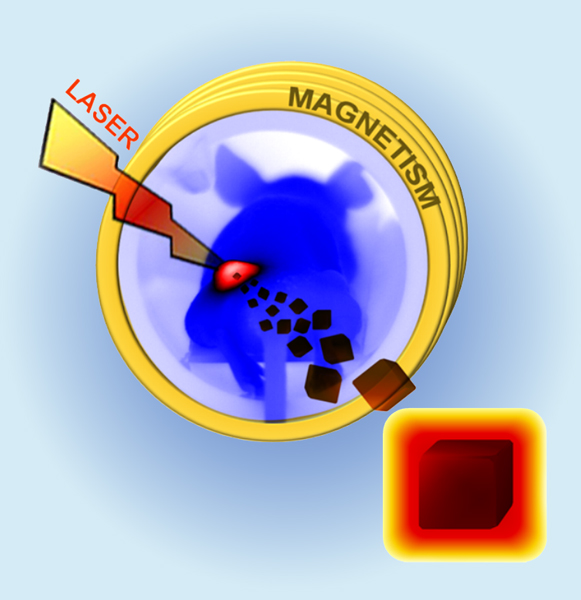
cancer with early detection and treatment, new strategies have emerged thanks to the development of nanomaterials exhibiting new properties stemming from the reduction of their size. One major mission of these nanomaterials is the promise to bring nano-physical therapies on target tissues, with precise temporal and spatial control of the therapeutic action, together with low side effects. These nano-physical therapies are mediated by nanoparticles cores that can be excited by a remote energy source (light, magnetism or radiation), and generate in turn a physical effect, such as heat, force, or field. In this context, we have been investigating the efficiency of magnetic hyperthermia, photothermia, and photodynamic therapy for cancer therapies, with the final aim to combine one with the other, for enhanced treatments at low nanoparticles doses.
Concerning thermal therapies, state-of-the-art modalities are the magnetic hyperthermia and the photothermal ones. Yet, for both, main limitations are the important doses of nanoparticles needed to achieve a therapeutic heating. Thus, the obvious question comes to mind: why not combine the two heat sources – magnetic and plasmonic – to enhance heating efficiency? We introduced this magneto-photo-thermal modality with magneto-plasmonic hybrids, or with iron oxide nanoparticles only. Indeed, we demonstrated that photothermia with magnetic nanoparticles could be proposed as an alternate to magnetic hyperthermia.
While the ultimate target for nanoparticle-mediated photothermal therapy is the cancer cell, heating performance has rarely been evaluated in cancer cells in vitro, or in vivo in the tumor environment.
In the attempt to bridge this gap, we provided magnetic hyperthermia measurements in the cellular environment and photothermal measurements of plasmonic nanoparticles in environments of increasing biological complexity, from aqueous dispersion to solid tumors, via tumor cells in vitro.
Selection of publications
- Photothermia at the nanoscale induces ferroptosis via nanoparticle degradation. Fromain A, Perez JE, Van de Walle A, Lalatonne Y, Wilhelm C. Nature Comm 14, 4637 (2023)
- Magnetite nanoparticle photothermal therapy in a pancreatic Tumor-on-Chip: A Dual-Action approach targeting Cancer cells and their microenvironment. A Dubrova, C Cavaniol, A Van de Walle, P Mathieu, Z Fusilier, N Yaacoub, Y Lalatonne, S Descroix, C Wilhelm. ACS nano, 19, 19790 (2025)
- Janus magnetic-plasmonic nanoparticles for magnetically guided and thermally activated cancer therapy. Espinosa A, Reguera J, Curcio A, Muñoz A, Van de Walle A, Liz-Marzán L, Wilhelm C. Small 16 1904960 (2020)
- Endosomal confinement of gold nanospheres, nanorods and nanoraspberries governs their photothermal identity and is beneficial for cancer cells therapy. Plan Sangnier A, Van de Walle A, Motte L, Guenin E, Lalatonne Y, Wilhelm C. Advanced Biosystems 4, 1900284 (2020)
- Raspberry-like small multicore gold nanostructures for efficient photothermal conversion in the first and second near-infrared windows. Plan Sangnier A, Aufaure R, Cheong S, Motte L, Palpant B, Tilley RD, Guenin E, Wilhelm C*, Lalatonne Y*. Chemical Communications, 55, 4055-4058 (2019)
- Iron Oxide Nanoflowers @ CuS Hybrids for Cancer Tri-Therapy: Interplay of Photothermal Therapy, Magnetic Hyperthermia and Photodynamic Therapy. Curcio A, Silva AKA, Cabano S, Espinosa A, Baptiste B, Menguy N, Wilhelm C*, Abou-Hassan A*. Theranostics, 9, 1288-1302 (2019)
- Magnetic (hyper)thermia or photo-thermia? Progressive comparison of iron oxide and gold nanoparticles heating in water, in cells, and in vivo. Espinosa A, Kolosnjaj-Tabi J, Abou-Hassan A, Plan Sangnier A, Curcio A, Silva AKA, Di Corato R, Neveu S, Pellegrino T, Liz-Marzán LM, Wilhelm C. Advanced Functional Materials 1803660 (2018)
- Intracellular Biodegradation of Ag Nanoparticles, Storage in Ferritin, and Protection by Au Shell for Enhanced Photothermal Therapy. Espinosa A, Curcio A, Cabana S, Radtke G, Bugnet M, Kolosnjaj-Tabi J, Péchoux C, Alvarez-Lorenzo C, Botton GA, Silva AKA, Abou-Hassan A, Wilhelm C. ACS nano 12, 6523–6535 (2018)
- Targeted thermal therapy with genetically engineered magnetite magnetosomes@RGD: Photothermia is far more efficient than magnetic hyperthermia. Plan A, Preveral S, Curcio A, Silva A, Lefèvre CT, Pignol D, Lalatonne Y, Wilhelm C. Journal of Controlled Release 279, 271-281 (2018)
- Duality of Iron Oxide Nanoparticles in Cancer Therapy: Amplification of Heating Efficiency by Magnetic Hyperthermia and Photothermal Bimodal Treatment Espinosa A, Di Corato R, Kolosnjaj-Tabi J, Flaud P, Pellegrino T, Wilhelm C. ACS Nano, 10, 2436-46 (2016)
- Cancer cell internalisation of gold nanostars impacts their photothermal efficiency in vitro and in vivo: towards a plasmonic thermal fingerprint in tumoral environment Espinosa A, Silva AKA, Sánchez-Iglesias A, Grzelczak M, Péchoux C, Desboeufs K, Liz-Marzán LM, Wilhelm C. Advanced HealthCare Materials, 5, 1040- 48 (2016)
- Combining magnetic hyperthermia and photodynamic therapy for tumor ablation with photoresponsive magnetic liposomes. Di Corato R, Béalle G, Kolosnjaj-Tabi J, Espinosa A, Clément O, Silva AKA, Ménager C, Wilhelm C. ACS Nano, 9, 2904-2916 (2015)